Overcoming Challenges through Indirect Time-of-Flight Advancements
Topics Covered
- Demand for 3D Sensing and the Role of Depth Sensing
- Applications of Depth Sensing
- Main Methods of Depth Sensing
- Depth Sensing Technologies
- Applications for Indirect Time-of-Flight with Hyperlux ID
White Paper Overview
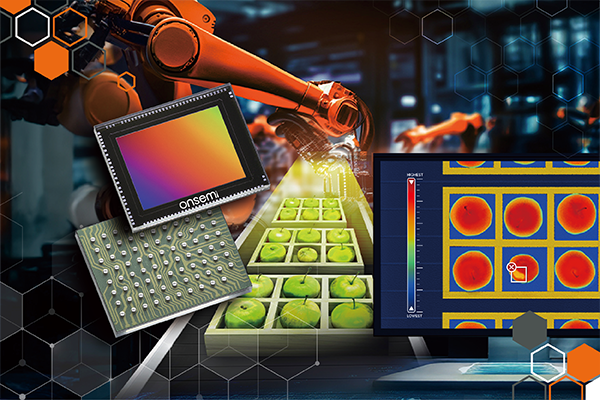
Used in applications such as robotics, industrial automation, autonomous vehicles, and healthcare, depth sensing is essential for accurate 3D mapping, object recognition, and spatial awareness, enabling adaptive and intelligent systems. This white paper examines those issues and also explores the main methods of acquiring depth data, with a particular emphasis on Indirect Time-of-Flight (iToF) technology, which offers real-time, pixel-level depth measurements.Download this white paper to discover how onsemi’s Hyperlux ID sensor family addresses the challenges of traditional iToF methods. The paper covers Hyperlux ID’s advanced features, including high resolution (1.2MP), improved distance accuracy, and integrated depth calculation. These innovations eliminate the need for external processors, reducing system complexity and power consumption.
The paper also highlights the potential of Hyperlux ID in diverse applications, from industrial automation to smart security and AR/VR. Key features such as dual-frequency sensing, high ambient light rejection, and extended range make Hyperlux ID a versatile solution for a wide array of depth-sensing needs. Explore how these technological advancements expand the possibilities of iToF and drive automation across multiple industries.
Thank You For Your Interest
By clicking ‘Submit’ you agree to our Terms of Use. We take your privacy seriously. For more information please read our Privacy Policy. By registering with All About Circuits you will automatically receive our weekly Product Update and Technology Insider eNewsletters.